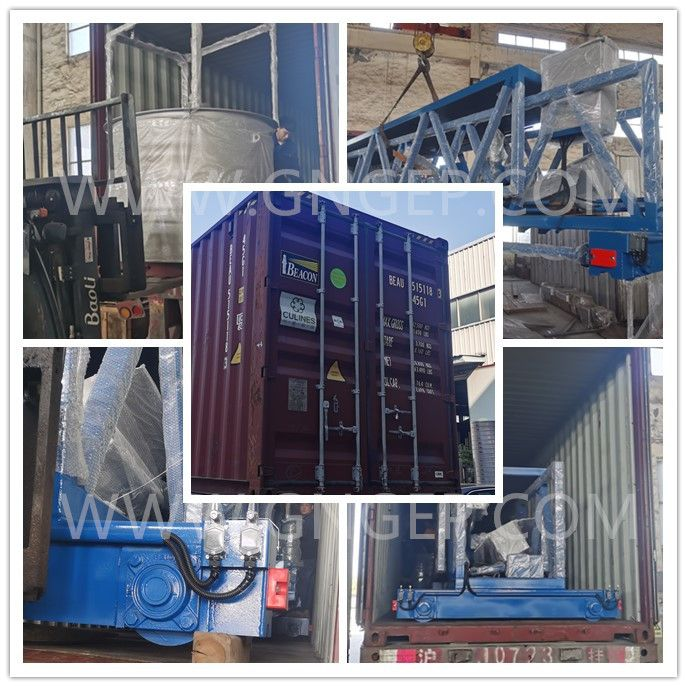
Today one set of Traveling Mud Scraper and one set of Traveling Slag Scraper were delivered to Indonesia. Traveling Mud Scraper and Traveling Slag Scraper were widely used in Refinery Wastewater Treatment.
The delivered equipment will be used to process over 20000 tons of mixed industrial wastewater per day, helping customers achieve efficient solid-liquid separation and sludge reduction goals, and promoting the transformation of green production.
Equipment Highlights: Intelligent Drive, Stable and Durable
The center drive scraper for this shipment adopts modular design, optimizing performance for high load industrial scenarios. The core advantages include:
Accurate sludge scraping: The torque adaptive adjustment system, combined with a 304 stainless steel scraper, can handle oily sludge and high viscosity impurities, with a sludge moisture content of ≤ 85%.
Long term operation: The imported gearbox and torque limiter provide dual protection, with a continuous operating life of over 10 years and a 60% reduction in failure rate compared to traditional models.
Intelligent control: equipped with IoT remote monitoring module, real-time feedback of device operation status, supporting automatic alarm and fault diagnosis.
This device is suitable for cleaning sludge from sedimentation tanks in municipal sewage treatment plants, chemical parks, paper mills, and other scenarios, especially suitable for complex water quality containing heavy metals and fiber suspended solids.
Project breakthrough: Customized solutions to industry pain points
The target park gathers electronic manufacturing, biopharmaceutical and other enterprises, and the wastewater has problems such as complex composition and poor sludge settling. The technical team has achieved a 30% increase in mud scraping efficiency and avoided the risk of metal component corrosion through non-metallic chain transmission design and multi-point pressure sensing system. The customer manager stated, "The device has a high degree of intelligence, and the operation and maintenance costs are only half of the original system, providing reliable support for water conservation and emission reduction in the park.