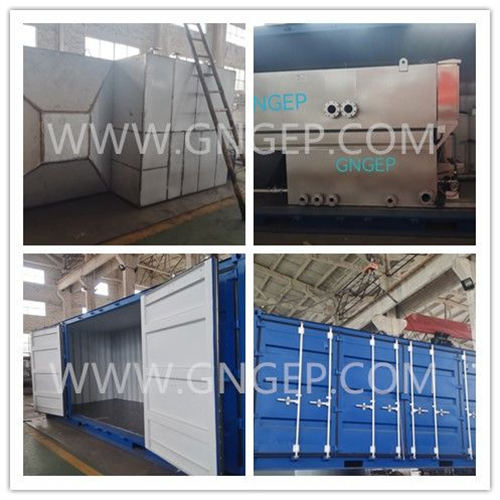
Today one set of Dissolved Air Flotation System(daf system) was delivered to Peru.
Today, GNGEP's independently developed high-efficiency dissolved air flotation machine was officially sent to a large-scale food processing enterprise's sewage treatment project. As the core equipment for wastewater pretreatment in the enterprise, this batch of daf dissolved air flotation will be used to treat 8000 tons of oily wastewater per day, significantly improving the efficiency of suspended solids and oil removal, and promoting customers to achieve clean production and water resource recycling goals.
Technical highlights: precise separation, intelligent operation
The high-efficiency air flotation system delivered this time adopts a two-stage process of vortex concave air flotation and dissolved air release, which has the following core advantages:
Efficient separation: The nanoscale dissolved gas release device generates 20-30 μ m microbubbles, with SS (suspended solids) removal rate ≥ 95%, oil separation rate ≥ 90%, and floating slag moisture content ≤ 92%.
Energy saving optimization: The energy consumption of the intelligent gas dissolution system is reduced by 35% compared to traditional models, and the gas dissolution efficiency is increased to over 98%.
Intelligent control: Integrated PLC control system, can monitor pH, turbidity and other parameters in real time, automatically adjust the dosage and reflux ratio, and achieve unmanned operation.
This equipment is suitable for the treatment of high concentration organic wastewater in industries such as food, printing and dyeing, and petrochemicals, and is particularly adept at treating complex water quality containing emulsified oil, colloids, and fine suspended solids.
Project value: Addressing industry pain points and empowering green transformation
The client company is facing long-term challenges such as high oil content in wastewater and rising pretreatment costs. The XX technical team has optimized the structure of the air flotation machine in a targeted manner, achieving precise control of the thickness of the floating slag layer through adjustable water distribution weir plates and a stepped slag scraping system. The consumption of chemicals has been reduced by 25%, and the treatment efficiency has been improved by 40%. After the project is put into operation, the COD and oil indicators of the customer's effluent will steadily meet the national first-class discharge standards, saving over one million yuan in wastewater treatment costs annually.