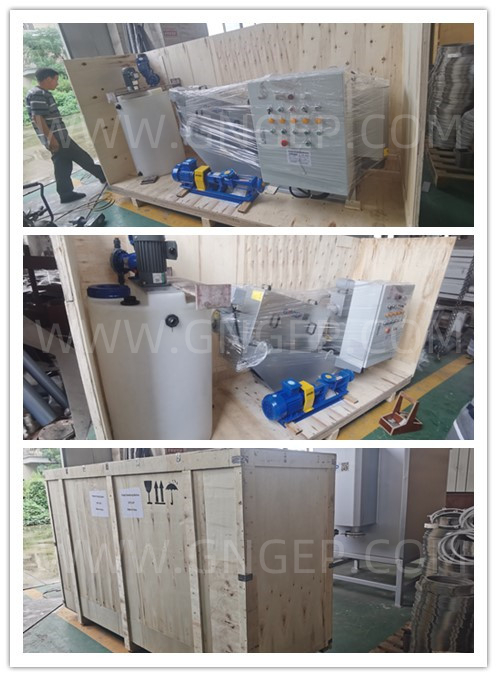
Today one set of Sludge Dewatering Machine and Polymer Dosing System were Delivered to Tanzania.
The collaborative application of screw press dewatering and automatic chemical dosing system in sewage treatment is mainly reflected in the following aspects:
1. Application Fields of screw press machine
Municipal sewage treatment: For organic sludge generated from domestic sewage, the combination of a screw dewatering machine and a fully automatic dosing device is used to achieve sludge reduction and stabilization treatment, meeting the continuous operation needs of urban sewage plants.
Industrial wastewater treatment: suitable for complex sludge generated in industrial fields such as printing and dyeing, electroplating, and papermaking. The flocculant type and dosing parameters need to be customized according to the characteristics of the sludge to ensure dewatering efficiency and effluent standards.
Special sludge treatment: such as oily sludge, high viscosity sludge, etc., improve sludge dewatering performance through precise control of dosing devices, and adapt to the mechanical extrusion dewatering process of screw stacking machines.
2. Technological synergy advantage of Dewatering screw press
Closed loop intelligent control: The dosing device dynamically adjusts the dosage of flocculant by monitoring parameters such as sludge concentration and flow rate online, and forms a linkage with the screw dewatering machine to improve system response speed and stability.
Accurate reagent matching: Select the appropriate flocculant (such as cationic/zwitterionic PAM) based on the properties of the sludge (such as organic matter content and charge characteristics), and ensure concentration consistency through an automatic dispensing system.
Continuous and efficient dewatering: The screw press achieves non clogging continuous dewatering through spiral extrusion, and the dosing device ensures the formation of sludge flocs. The two work together to stabilize the moisture content of the sludge cake below 75% and the turbidity of the filtrate below 30NTU.
3. Drug selection and optimization
Types of coagulants: Municipal sludge commonly uses cationic polyacrylamide (PAM), printing and dyeing sludge requires zwitterionic or specialized formula agents, and oily sludge may require complex demulsifiers.
Dosage control: Usually added at a rate of 0.1% -0.3% of the dry weight of sludge, which needs to be determined through small-scale testing; The dosing device can be equipped with a metering pump with a flow rate of 0.5-10L/min, suitable for different processing scales.
Concentration ratio: The powdered drug is automatically diluted to a solution concentration of 0.1% -0.5% through a foaming machine to avoid affecting the flocculation effect due to uneven concentration.
4. Application effect
Dehydration efficiency: The volume of the mud cake is reduced by 60% -70%, and the moisture content is reduced from over 98% to below 75%, significantly reducing transportation and disposal costs.
Operating cost: precise dosing reduces drug waste, the energy consumption of the screw stacking machine is low (about 1-3kW · h/t DS), and the comprehensive energy saving is over 30%.
Environmental benefits: The fully enclosed design avoids the escape of odors, and the reuse of filtrate reduces water resource consumption, meeting the requirements of green treatment.