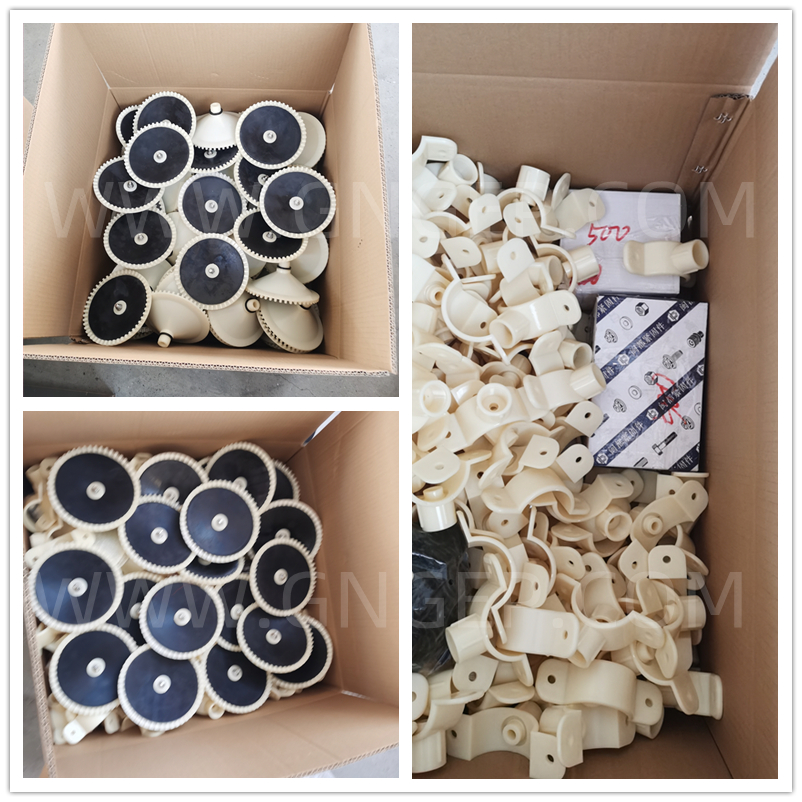
Today hundreds of coarse bubble diffusers were delivered to Malaysia.
Disc type coarse bubble diffuser
Taking the 5-inch (125mm) specification as an example, it is made of rubber diaphragm material and fixed to the support body through threads. The bubble diameter is relatively large (usually 1-3mm), which is suitable for low to medium load sewage treatment scenarios. Its structure is compact, easy to install and maintain, and can be connected to pipelines through soft joints or saddles.
Tubular microporous aerator
Although the name contains "micropores", some products are also classified as coarse pores, using polyethylene or EPDM materials, with a design that can be improved and can be repaired without draining water. Its oxygen utilization rate is high, resistance loss is low (1500-2500Pa), service area is about 6 times that of a disc, and it is suitable for high load treatment of industrial wastewater, etc.
Vibration aerator
By combining mechanical vibration and aeration functions, high-frequency vibration is used to enhance the diffusion effect of bubbles and improve oxygen transfer efficiency. It is commonly used in biochemical tanks that require enhanced stirring.
Application scenarios and industry demands of coarse diffuser
Coarse air diffuser is widely used in the field of sewage treatment, covering the following scenarios:
Municipal sewage treatment
Biochemical treatment processes suitable for urban domestic sewage, such as oxidation ditch, A/O method, etc., promote microbial degradation of organic matter through efficient oxygenation.
Industrial wastewater treatment
Acid and alkali resistant materials (such as polyethylene and EPDM) can adapt to complex water quality environments for high concentration organic wastewater in industries such as petrochemicals, textiles, printing and dyeing, and pharmaceuticals.
Aquaculture oxygenation
In high-density aquaculture ponds, by increasing the dissolved oxygen content in the water, the living environment of aquatic organisms can be improved, but the ventilation rate needs to be adjusted according to the scale of aquaculture.