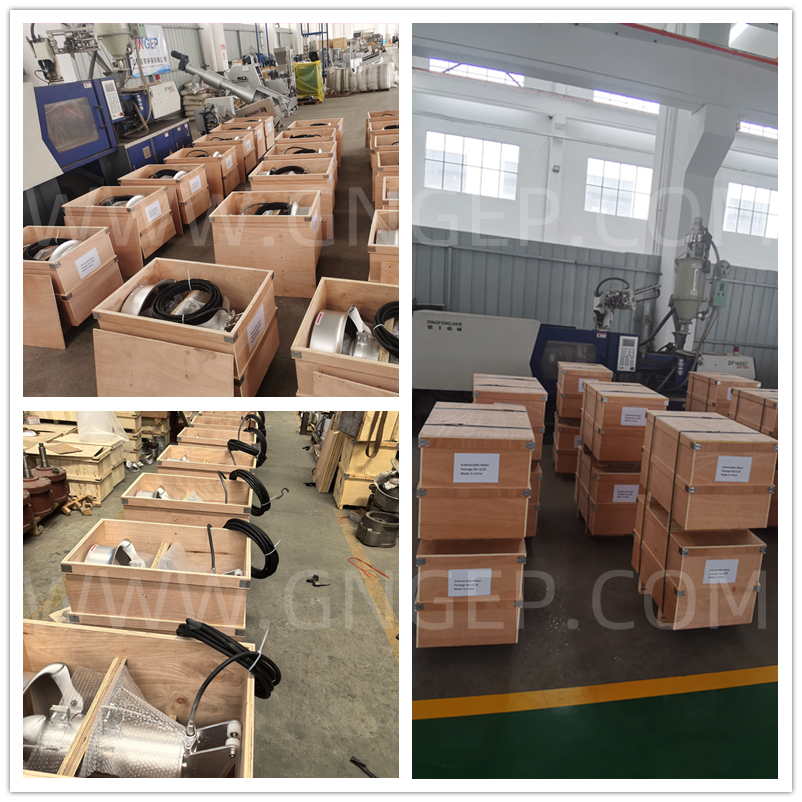
Today hundreds of Submersible Mixeres were delivered to Brazil.
Submersible mixer: the core equipment for sewage treatment and water circulation
A submersible mixer (also known as a submersible thruster) is a specialized underwater mixing equipment that uses a motor to drive the impeller to rotate, converting kinetic energy into mechanical energy to achieve functions such as mixing, stirring, and sedimentation prevention in water bodies. It is widely used in municipal/industrial wastewater treatment, landscape water maintenance, concrete mixing, and other fields.
1、 Core classification and working principle
Divided into two categories by function:
Mixing mixer: Adopting a multi-stage motor and direct connection structure, the impeller has high stamping accuracy and strong thrust, suitable for solid-liquid mixing and rapid mixing scenarios (such as sewage tank homogenization).
Low speed impeller: Adopting a single-stage cycloidal pinwheel reducer, the impeller has a wide and thin sweep, low speed, and strong thrust flow. It is suitable for scenarios such as oxidation ditches that require gentle circulation and avoid damaging sludge flocs.
working principle
The motor drives the impeller to rotate at high speed, generating strong circulation and tangential flow, which disperses suspended solids and sediments at the bottom of the pool back into the water, while increasing dissolved oxygen in the water, promoting microbial activity, and improving sewage treatment efficiency.
Core application scenarios
Wastewater treatment: prevent sludge from settling at the bottom of the tank and ensure the stable operation of the biochemical treatment system; Promote the mixing of sewage and chemicals to improve reaction efficiency.
Industrial wastewater: Treat industrial wastewater containing fibers and high concentration suspended solids to avoid pipeline and equipment blockages.
Landscape water maintenance: By circulating water flow, the oxygen content of the water is increased to prevent the growth of algae and the deterioration of water quality.
Other scenarios: concrete mixing (to improve uniformity), port and waterway dredging (to prevent sediment accumulation), etc
Key points of selection
The selection should be comprehensively judged based on the process objectives, pool parameters, and medium characteristics. The core logic is as follows:
Clear process requirements: choose low-speed impeller impeller impeller for mild flow, large impeller impeller impeller impeller impeller impeller for anti sedimentation, and mixing mixer for fast mixing.
Matching pool parameters: Accurately measure the length, width, and effective water depth of the pool, calculate the volume, determine the number and layout of equipment (guide rod suspension/fixed).
Adaptive medium characteristics: For media with high fiber/hair content, choose anti entanglement impellers; Choose 316L stainless steel material for corrosive wastewater (such as chemical wastewater); In scenarios with high sludge concentration, a power margin of 20-30% needs to be reserved.
Core performance indicators: The motor protection level should reach IP68 (waterproof and dustproof), and the insulation level should be Class F; The impeller is made of polyurethane or stainless steel material, which is wear-resistant and corrosion-resistant.