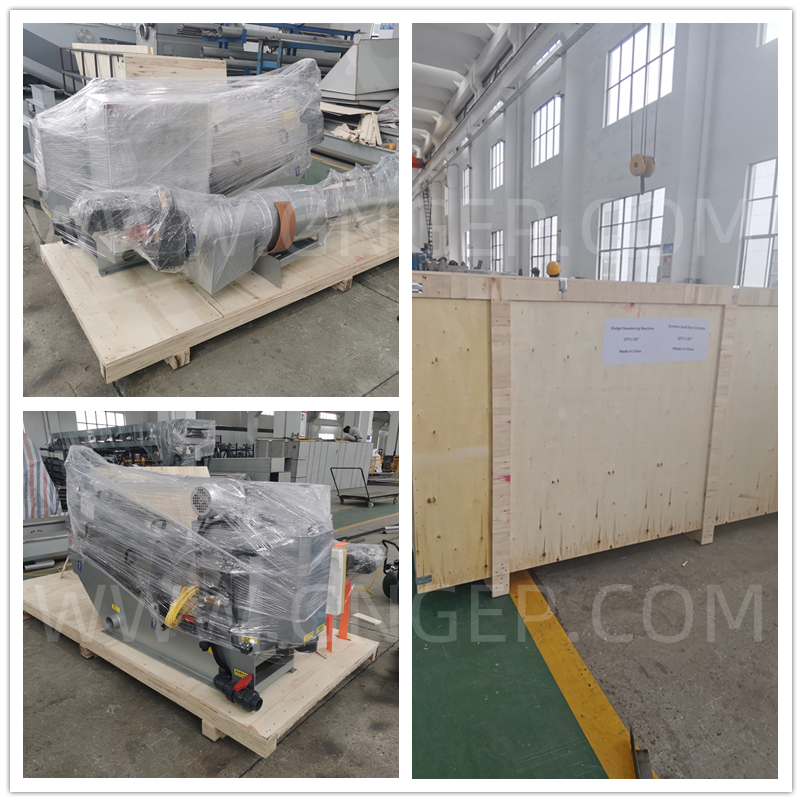
The sludge dewatering machine is the core equipment in the sewage treatment process, and its core value lies in the efficient solid-liquid separation of sludge with a moisture content of over 95%, achieving reduction, stabilization, and resource utilization, laying the foundation for subsequent disposal processes such as incineration, landfill, and land use. A sewage treatment plant with a daily processing capacity of 100000 tons can produce hundreds of tons of wet sludge per day, and the cost of dewatering accounts for 20% -30% of the total treatment cost.
Working principle and core performance
Mainstream equipment integrates multiple processes such as negative pressure adsorption, gravity settling, and roll extrusion to achieve continuous automated operations
Stacked screw type: By dynamically squeezing the spiral shaft and the dynamic and static ring plates, the sludge moisture content is reduced from 95% to below 80%. The daily processing capacity of a single unit can reach 50-200 tons, and the efficiency is increased by 40% compared to traditional belt conveyors.
Plate and frame type: In a sealed state, the sludge is driven by a high-pressure pump to be extruded through a filter cloth, achieving solid-liquid separation.
Centrifugal: Using the centrifugal force generated by high-speed rotation, the water in the sludge is thrown out to achieve rapid dewatering.
The moisture content of the filter cake of qualified equipment can be stably controlled at 9% -19% (meeting the requirements of landfill and incineration), and the cleanliness of the separated water is high. The recycling rate can reach 68%, and a single person can be on duty, reducing labor input by 32%. The overall power consumption of the machine is low, and the maintenance cycle can reach more than 30 days.
Municipal sewage treatment plant (domestic sludge)
Industrial wastewater treatment (sludge from industries such as printing and dyeing, papermaking, electroplating, petrochemicals, pharmaceuticals, and food)
River dredging and sediment dewatering, drilling mud treatment, building materials factory mud dewatering, etc
Key points of selection
Mud analysis is a prerequisite: the viscosity and particle composition of sludge from different sources (domestic sludge vs oily/heavy metal industrial sludge) vary greatly, and it is necessary to conduct mud sample analysis and small-scale testing first to determine the appropriate model and flocculant type.
Matching processing capacity and site: Single machine processing capacity covers 6-225m ³/h, and compact architecture equipment is more suitable for sewage stations with limited space.
Automation and stability: Prioritize equipment with automatic correction, automatic cleaning, and PLC control to reduce manual labor intensity and ensure 24-hour continuous operation.