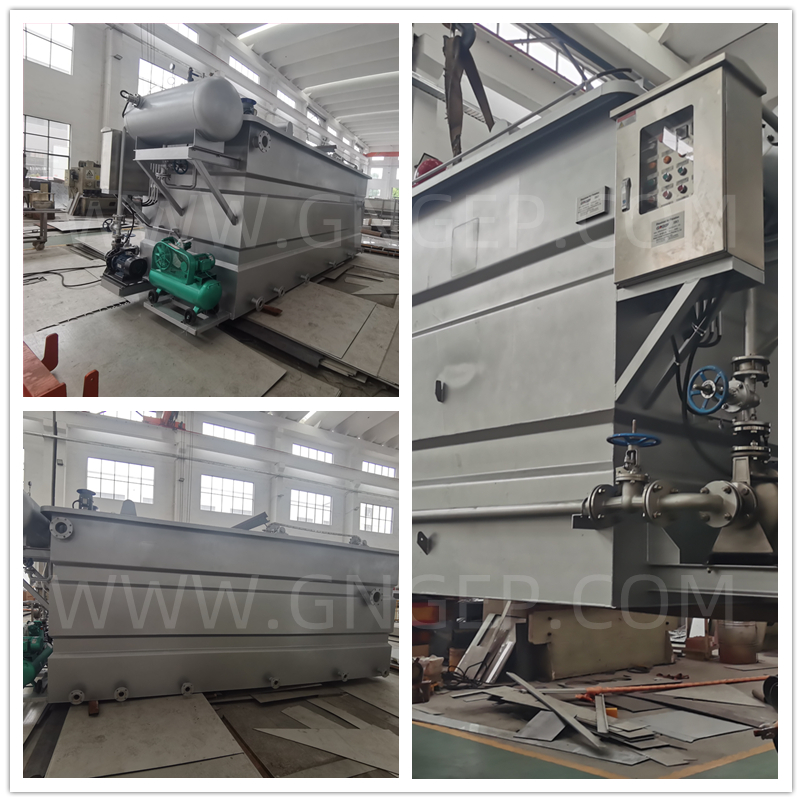
Today one set of Dissolved Air Flotation were delivered to Sri Lanka.
Air flotation equipment is a water treatment device that uses microbubbles to attach suspended particles and utilizes buoyancy to achieve solid-liquid/liquid-liquid separation. The core principle is to allow air to enter the water in the form of highly dispersed microbubbles, so that pollutants have a lower density than water and float to the surface, thereby achieving purification or separation.
working principle
Taking dissolved air flotation as an example:
Raw water is mixed with dissolved water, and microbubbles adhere to the surface of suspended particles.
The density of the bubble particle composite is lower than that of water, and it rises to the water surface with buoyancy to form floating debris.
By using a scraper to remove floating slag, solid-liquid separation can be achieved, and the effluent can be discharged or reused in compliance with standards.
Core application scenarios
Municipal/water supply field: Separate fine suspended solids, algae, and microorganisms from surface water to improve the pre-treatment quality of water plants.
Industrial wastewater treatment:
Paper industry: Recycling pulp from wastewater and treating wastewater from paper making (when the influent COD is ≤ 3000mg/L, the effluent COD can be controlled between 50-200mg/L).
Chemical/Leather/Pharmaceutical: Treat high concentration organic wastewater, reduce environmental load, and ensure water quality safety.
Food processing/brewing: treating high suspended solids wastewater to promote clean production.
Sludge treatment: replacing secondary sedimentation tanks to achieve sludge concentration and dewatering, reducing subsequent treatment costs.