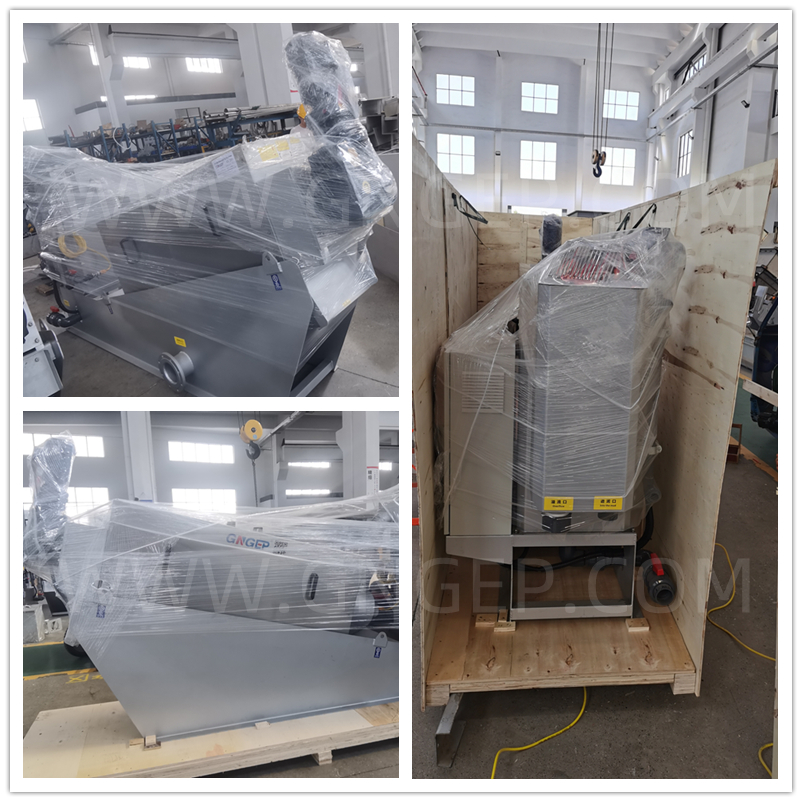
Today one set of sludge dewatering machine was delivered to Sri Lanka.
Working principle and technical characteristics of screw press sludge dewatering machine
Dewatering screw press machine is a key equipment that separates water from sludge and reduces its moisture content through physical or mechanical means. It is widely used in fields such as sewage treatment and industrial wastewater treatment. The core principle is to use mechanical force (such as extrusion, centrifugation, filtration) or gravity separation to achieve solid-liquid separation. The following are the working principles and technical characteristics of mainstream types:
Main types and working principles
Stacked screw sludge dewatering machine
Structure: The filtering body is formed by alternately stacking fixed rings and moving rings, with a spiral shaft passing through it.
Process: After entering the spiral drum through the feeding port, the sludge is dehydrated by gravity concentration and internal pressure generated by spiral propulsion. The filtrate is discharged from the inter ring filter, and the sludge cake is discharged from the end.
Core advantage: No filter cloth design to avoid blockage; Low speed operation (such as a screw shaft speed of about 30r.p.m.) results in low energy consumption.
Belt type sludge dewatering machine
Structure: Two tension filter belts on top and bottom, combined with a roller press cylinder to form a pressing path.
Process: The sludge is first dehydrated by gravity to remove free water, then enters the wedge-shaped preloading zone and the "S" - shaped pressing section, and is further dehydrated by rolling shear force. Finally, the sludge cake is removed by a scraper.
Key design: Some equipment adopts vertical fiber filter cloth, which reduces sludge adhesion and reduces cleaning water volume through electrostatic implantation technology.
Centrifugal sludge dewatering machine
Structure: Composed of a rotary drum and a screw conveyor, it uses centrifugal force to separate solid and liquid.
Process: The sludge is fed into the rotary drum through a hollow shaft, and under high-speed rotation (centrifugal force), the liquid phase overflows from the weir, while the solid phase is pushed to the discharge port by a spiral.
Efficient dehydration and low energy consumption
The dehydration efficiency of the screw stacking machine can reach below 80% moisture content, with a unit power consumption of only 0.1 kWh/kgDS; The belt conveyor achieves an increase in the solid content of the mud cake through multi-stage pressing (such as pre pressing roller+main pressing roller).
Centrifugal equipment has a large processing capacity and is suitable for large-scale sewage treatment plants.
Automation and operational convenience
Modern equipment is commonly equipped with PLC control systems, which can automatically adjust parameters such as feed rate and pressing pressure, and support 24-hour unmanned operation.
The filter cloth cleaning system of the belt machine (such as 4kg/cm ² water pressure fan-shaped spray) can automatically maintain the permeability of the filter cloth.
Environmental adaptability and multifunctionality
Widely applicable sludge types: municipal sludge, industrial wastewater sludge (printing and dyeing, electroplating, papermaking), kitchen waste, etc.
The screw stacking machine has no odor overflow and low noise (<65dB), suitable for environmentally sensitive scenarios; The plate and frame machine is suitable for the treatment of high viscosity sludge.