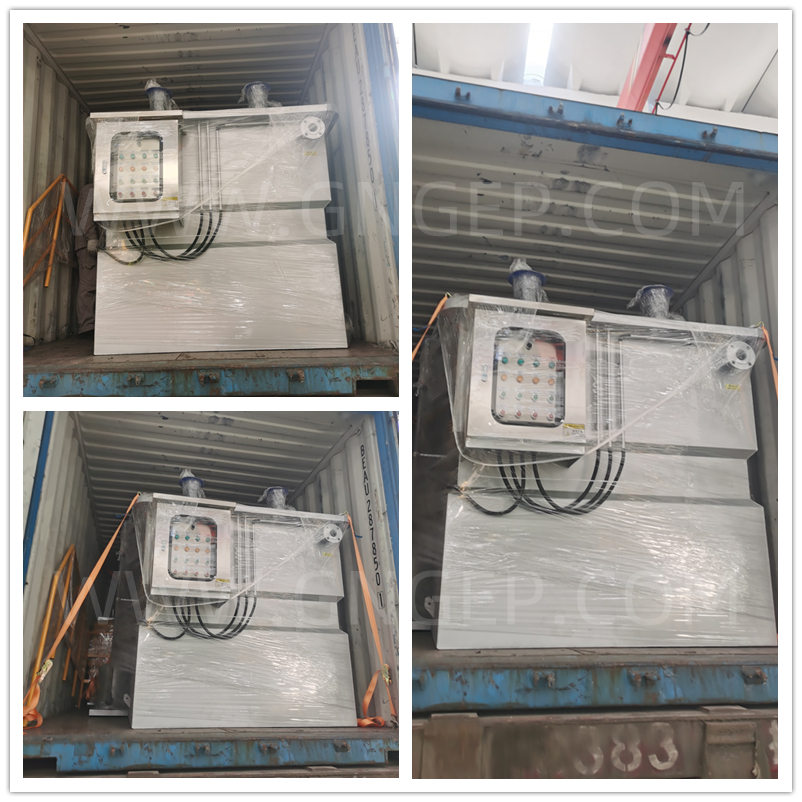
Today one set of Dissolved Air Flotation was delivered to Philippines.
Definition and working principle of Dissolved Air Flotation
Dissolved air flotation system is a water treatment device that separates water from suspended solids by causing them to adhere to bubbles and rise to the water surface. The core principle is to utilize the hydrophilic or hydrophobic properties of suspended particles on the surface, convert hydrophilic particles into hydrophobic ones through chemical agents (such as coagulants), or use the network structure of flocs to trap bubbles, so that the overall density of suspended particles combined with microbubbles is lower than that of water, and then separate them by buoyancy. In addition, the foam formed by surfactants (such as detergents) in water can also assist the rise of suspended particles.
Main types and characteristics of air flotation equipment
Electrolytic dissolved air flotation machine
Working method: By electrolyzing wastewater through insoluble anodes and cathodes, hydrogen and oxygen microbubbles are generated to attach pollutants and float up.
Advantages: The bubble size is extremely small, with a wide range of pollutants to be removed. It has the functions of oxidation, decolorization, and sterilization. The sludge volume is small, the land occupation is small, and there is no noise.
Limitations: The high energy consumption and plate loss of electrolysis, as well as the high operating costs, limit its promotion and application.
Scattered air flotation equipment
Working method: Relying on the centrifugal force of high-speed rotating impellers to suck in air, forming bubbles with a diameter of about 1mm, and driving suspended solids to float up.
Disadvantage: Large bubbles make it difficult to adsorb small particles and flocs, easily break flocs, and not suitable for treating fine pollutants.
Daf dissolved air flotation
Classification: It is divided into pressurized dissolved air flotation and dissolved air vacuum flotation, among which pressurized dissolved air flotation is the most widely used.
Principle of pressurized gas dissolution: Water is pressurized to 3-4 × 10 ⁵ Pa and dissolved in air. After decompression, microbubbles with a diameter of 20-100 μ m are released, and the attached suspended solids float up.